Journal

Topic: Research

2017

Upakovka (Packaging), 5/2017

Pressure-plate drive mechanism in die-cutting equipment: justification of the improvement

This trade-journal article justifies the need to improve the pressure-plate drive mechanism used in die-cutting equipment. It describes the technological demands of die-cutting, identifies the shortcomings of the existing drive, and outlines directions for its modernisation to raise productivity and cutting quality. The article sets the practical context for the author’s research on improved drive mechanisms.

2016

Printing and Publishing

Kinematic synthesis of a die-cutting press mechanism from the condition of equal forward and return strokes

This paper performs the kinematic synthesis of a die-cutting press mechanism under the condition of equal forward and return strokes of the pressure plate. Analytical relationships are derived that size the mechanism links so that the working and idle strokes are balanced, which stabilises the machine’s cyclic motion. The synthesised mechanism provides a basis for a smoother, better-balanced die-cutting drive.

2016

Technological Complexes, 2016, No. 1 (13)

Automated synthesis of mechanism of press of diecutting machine

This paper presents a methodology for optimising the main press mechanism of a die-cutting machine to improve productivity and manufacturing quality while reducing drive power. Analytical dependencies are derived for mechanism synthesis, and dedicated software is developed to analyse and visualise candidate kinematic schemes. The resulting workflow supports a strictly vertical pressure-plate motion and provides an automated engineering tool for selecting mechanism parameters.

2025

Australian Journal of Mechanical Engineering

Research of the wedging mechanism with additional driven crank and gear transmission in the pressure plate drive of the die-cutting press

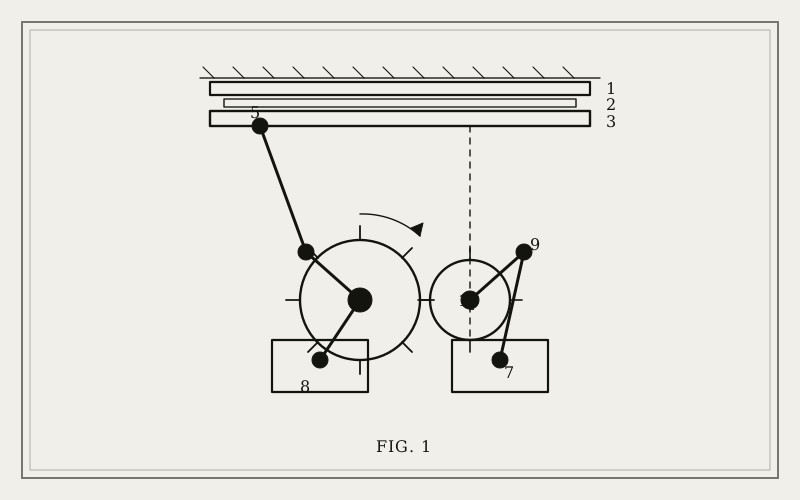
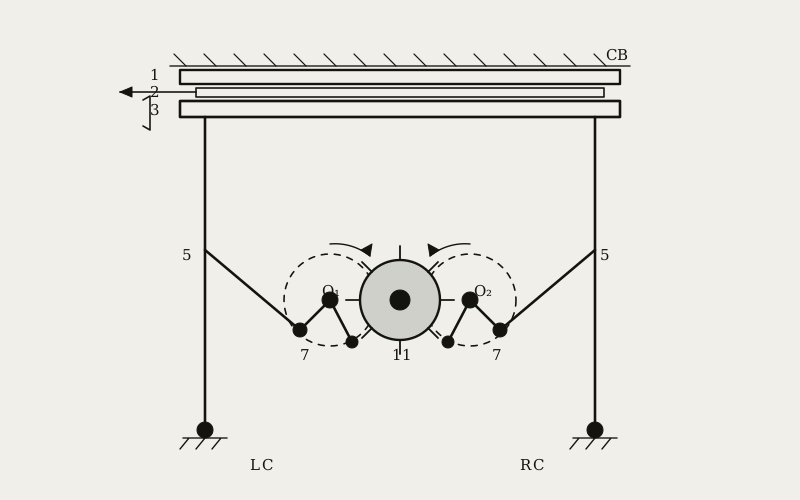
Scientific research on die-cutting press pressure-plate drive mechanisms is analysed and, based on the results, an upgraded drive is proposed that combines two wedging mechanisms, an additional pair of driven cranks, and a gear transmission. A geometric synthesis of the mechanism determines its relative and absolute dimensions, and a methodology based on similarity theory is developed to calculate its kinematic parameters, yielding analytical expressions for the invariants of the mechanism’s motion. A 3D model is designed from the synthesis results and a virtual experiment is conducted in SolidWorks. For a press operating at 60 cycles per minute with an 80 mm plate displacement, the maximum speed reaches 0.372 m/s while inertial loads at plate reversal remain minimal (negative acceleration of −0.139 m/s²), confirming the effectiveness of the proposed drive.

2024

Scientific Papers of the Ukrainian Academy of Printing

Application of a two-section pressure plate in a die-cutting automaton press: prospects of abandoning the monoblock design

The die-cutting of large-format cardboard concentrates very high forces on the pressure plate and its drive. This paper argues for replacing the traditional monoblock pressure plate with a two-section design, in which the plate is split into independently driven sections. Dividing the load between sections lowers the instantaneous force on the drive, reduces plate deformation, and improves the uniformity of cutting and creasing. The study defines the conditions under which the two-section plate is justified for high-capacity die-cutting automata.

2024

International scientific conference proceedings

Reasoning for the use of a crank-gear drive of the pressure segment in the die-cutting press

This conference paper reasons for the use of a crank-gear drive of the pressure segment in a sectional die-cutting press. It shows how combining a crank mechanism with a gear transmission shapes the motion of the pressure segment, increasing the dwell during cutting and reducing inertial loads. The proposed drive is presented as a route to higher productivity and better cut quality in sectional die-cutting equipment.

2023

Printing and Publishing, 2023 / 2 (86)

Research on the pressure plate movement by the drive with wedging mechanisms in the die-cutting press

This paper studies the movement of the pressure plate driven by wedging mechanisms in a flat die-cutting press. Analytical relationships are derived for the displacement, velocity, and acceleration of the plate over the working cycle, and the influence of the wedging-mechanism parameters on the motion is examined. The results show how the wedging drive shapes the plate’s approach and dwell during cutting, providing a basis for tuning the drive to reduce impact and improve cut quality.

2023

Academic Journal of Manufacturing Engineering, Vol. 21, Issue 3

Combined double crank wedging drive mechanisms of the press plate used in die-cutting press: synthesis, kinematic and functional

This study examines schemes of combined double-crank wedging drive mechanisms for the pressure plate of a die-cutting press and defines the conditions for their application. Structural and geometric synthesis of the mechanisms is performed, and their kinematic and functional characteristics are derived analytically. The combined double-crank wedging arrangement is shown to increase dwell during the cutting phase and to smooth the plate’s motion, improving the quality and stability of cardboard die-cutting. Recommendations are given for selecting the scheme parameters according to the required press cyclicity.

2014–2026

Researcher / inventor

Die-cutting press drive mechanisms (research)

A decade of research and invention on the drive mechanisms of flat die-cutting presses — the machines that cut, crease, and emboss cardboard packaging. The work targets the pressure-plate drive, where large, uniform forces must be delivered with stable, repeatable motion and minimal inertial loading. It combines analytical modeling, CAD/CAE simulation, physical experiment, and patented technical solutions, and forms the basis of a Ph.D. dissertation and a series of peer-reviewed publications.

Approach

  • Structural and geometric synthesis of wedging and combined double-crank drive mechanisms.
  • Analytical models of kinematic and power parameters, with calculations in Mathcad and similarity theory.
  • 3D models and virtual experiments in SolidWorks Motion to validate displacement, velocity, acceleration, and torque.
  • Experimental study of cardboard cutting to interpret real resistance torques against the analytical models.

Outcomes

  • Improved drives that reduce pressure-plate oscillation and inertial loads while increasing productivity and cut quality.
  • 11 issued Ukrainian patents and a body of articles in national and international (Scopus-indexed) journals.
  • Solutions cited in later academic literature, dissertations, and patents as prototype technology.

See the full record on the Publications and Patents & certificates pages.
2015

Scientific Notes, 2015

Research mechanisms of printing and packing machines in specialized computer aided design

This article describes a specialised computer-aided design program for studying the mechanisms of printing and packaging machines. The software allows a mechanism to be constructed visually, animated, and analysed for its kinematic parameters, and it generates 3D models that can be exported to other CAD systems. By combining synthesis, visualisation, and analysis in one environment, the tool accelerates the early design of linkage mechanisms. Its application to printing and packaging machinery is demonstrated.