
DXNest is a CAD/CAM software system for automated production preparation in sheet-metal and facade fabrication. It reads DXF drawings and Excel part lists, nests parts onto stock sheets, and generates CNC programs, bills of materials, packing slips, labels, PDF documents, and Excel reports — replacing hours of manual drafting and CNC preparation.
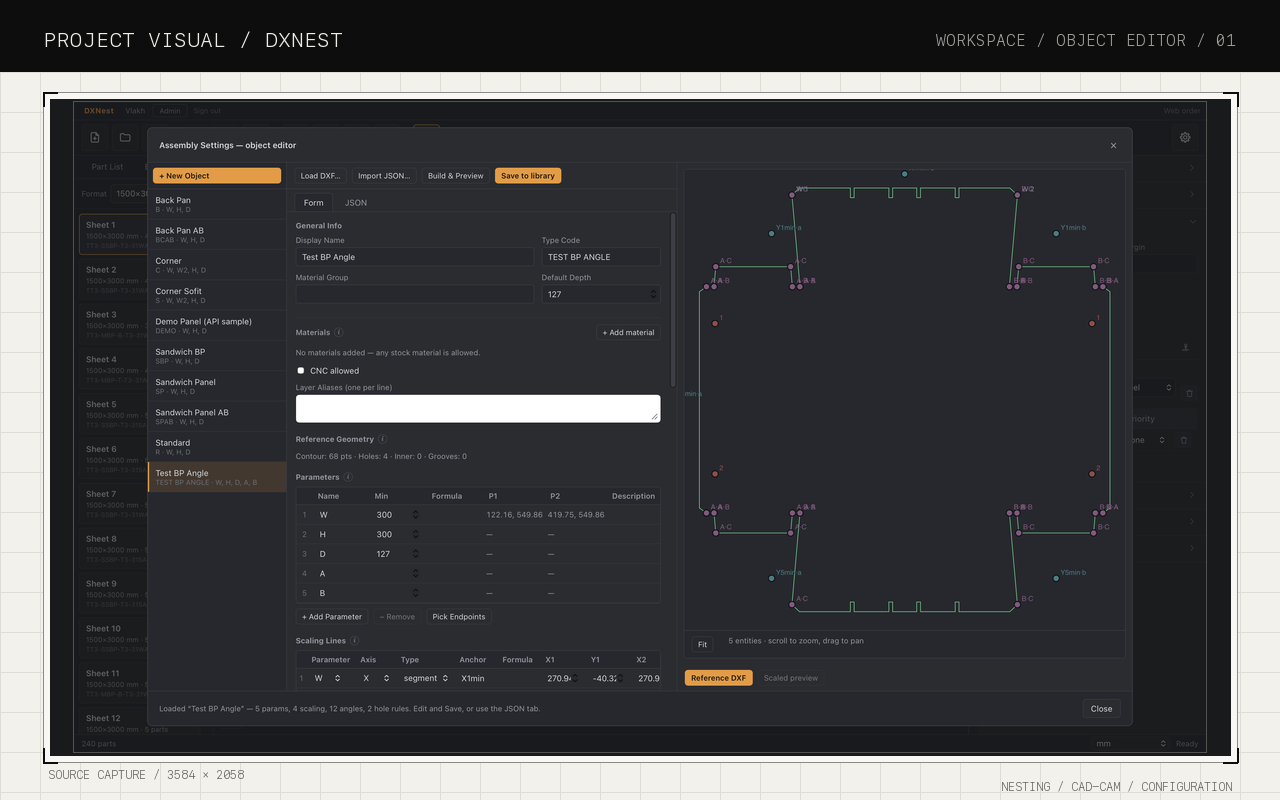
What it does
- Reads DXF drawings and Excel part lists, detects contours and geometry, and validates parts before production.
- Nests parts across multiple sheet sizes with rotation, spacing, boundary, and collision constraints to reduce waste.
- Generates CNC programs, bills of materials, packing slips, labels, material estimates, waste calculations, and PDF/Excel reports.
- Provides an interactive interface for part configuration, parametric geometry editing, material/sheet selection, and job management.
Engineering results
- Preparation of a 40-panel job reduced from about 2 hours to roughly 5 minutes.
- A 300-part drawing-to-CNC workflow completed in about 15 minutes instead of nearly a full working day.
- Material, sheet-format, and part-template libraries supporting ~10 projects and ~900 sheet-metal parts.
Architecture & stack
Modular architecture separating the interface, DXF geometry engine, nesting algorithms, CNC-generation modules, and export functionality. The desktop application is built with Python, PyQt6, ezdxf, Shapely, pandas, openpyxl, and NumPy; a web version extends access to nesting, project management, and file generation. Development is version-controlled across separate desktop, web, and website repositories.
Intellectual property
DXNest is registered with the Canadian Intellectual Property Office — Copyright Registration No. 1238472 (2025). View the copyright certificate (PDF). Live product: dxnest.io.