
A family of custom engineering programs for the synthesis, kinematic and dynamic analysis, and visualization of machine mechanisms, applied in scientific research, university courses, and industrial experiments. Several generations were built — from Delphi / Object Pascal desktop applications to a modern React + Python web version, which is now continued commercially as DXNest Motion.
Capabilities
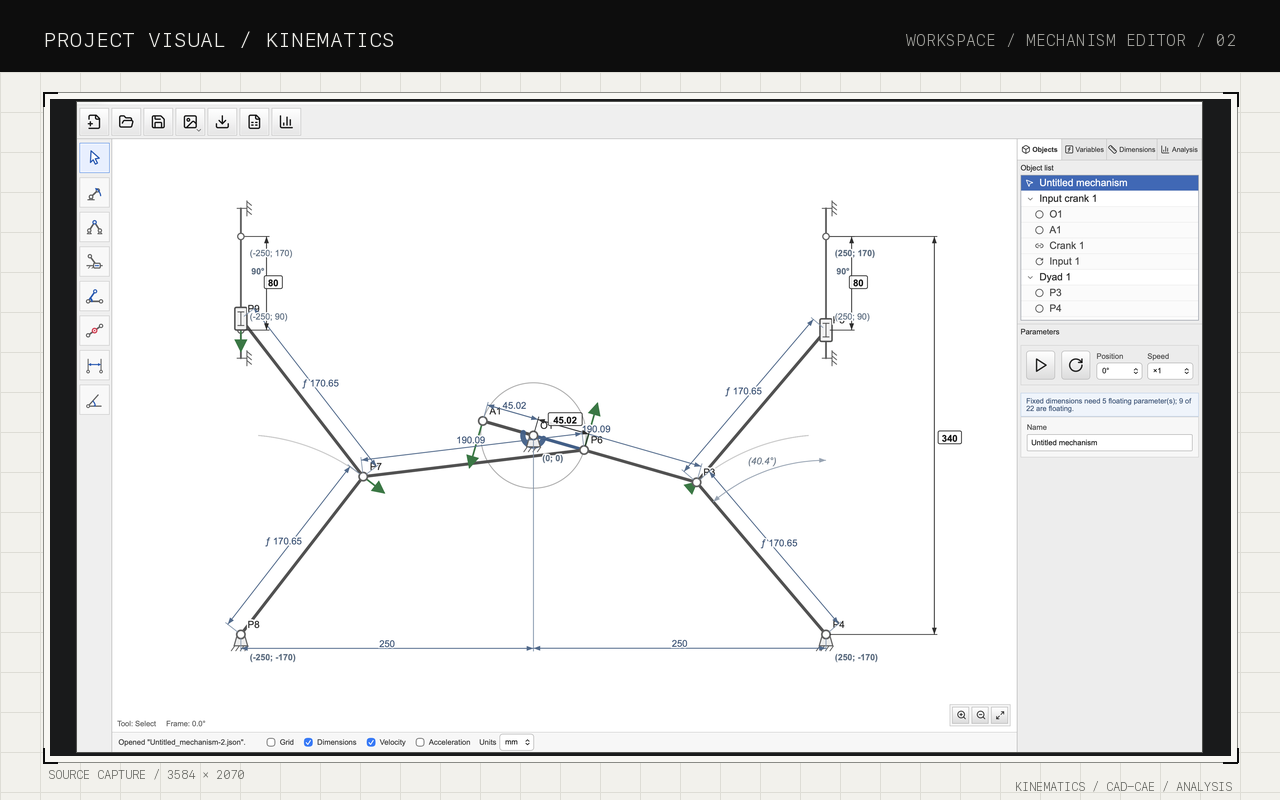
- Automated kinematic and dynamic analysis of crank mechanisms, linkages, cam mechanisms, kinematic pairs, and Assur groups.
- Calculation of positions, trajectories, velocities, accelerations, link and angular parameters, forces, reactions, and driving torque over a full cycle.
- Interactive construction, animation, trajectory and vector visualization, and engineering dimensioning.
- Export and reporting to JSON, CSV, SVG, DXF, XLSX, PNG/JPEG, AutoCAD drawings, Excel tables, and Word reports, including AutoLISP generation of 3D models for AutoCAD.
Registered software
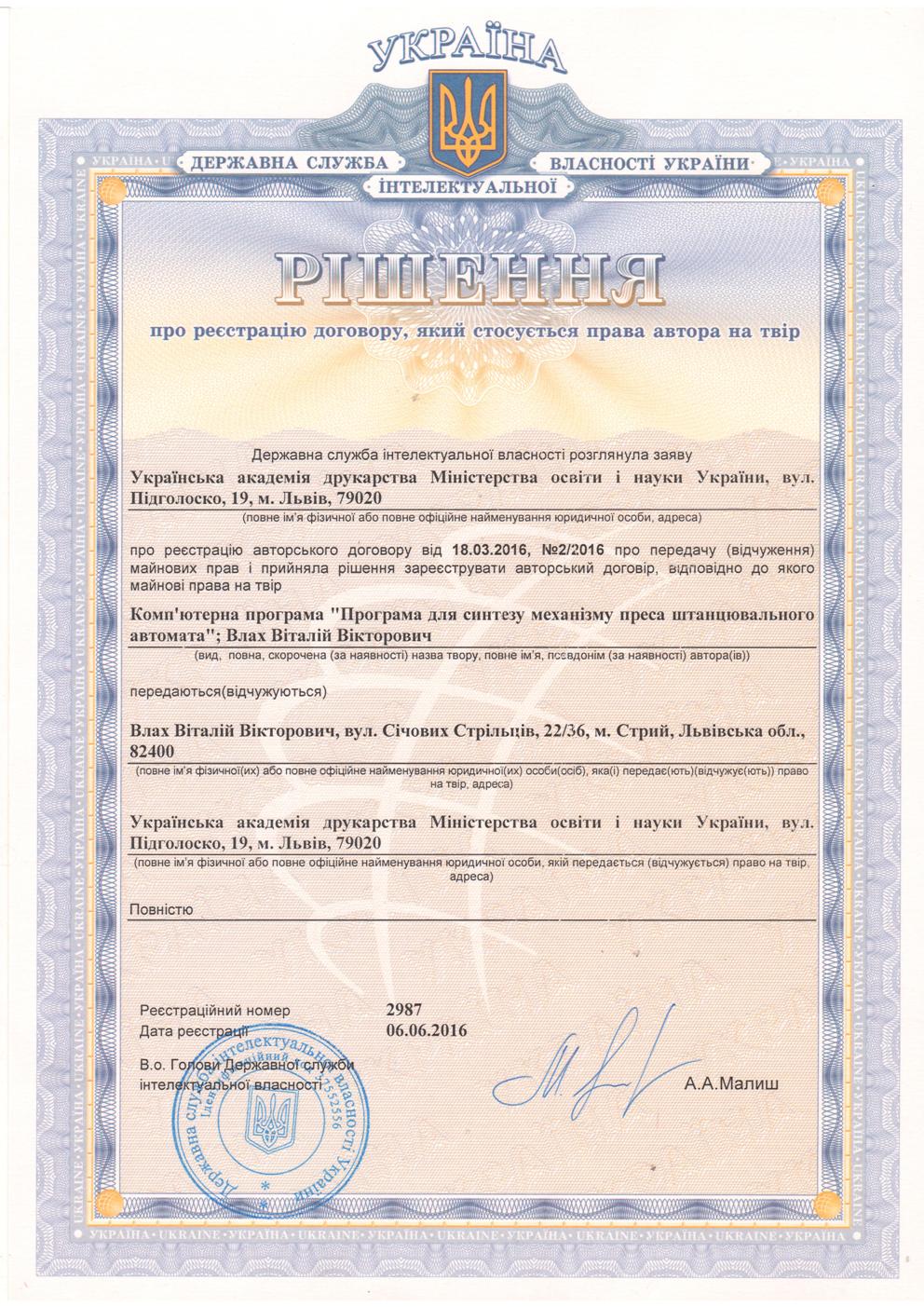
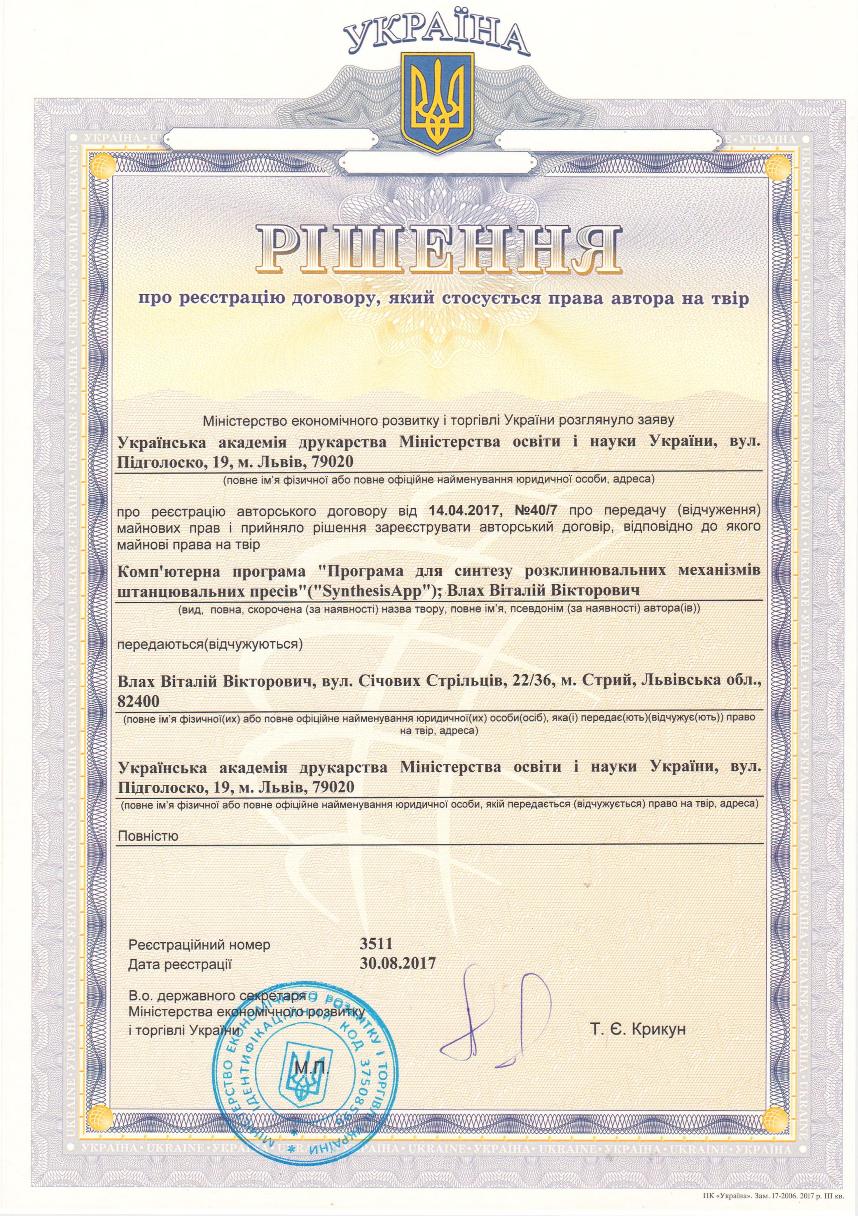
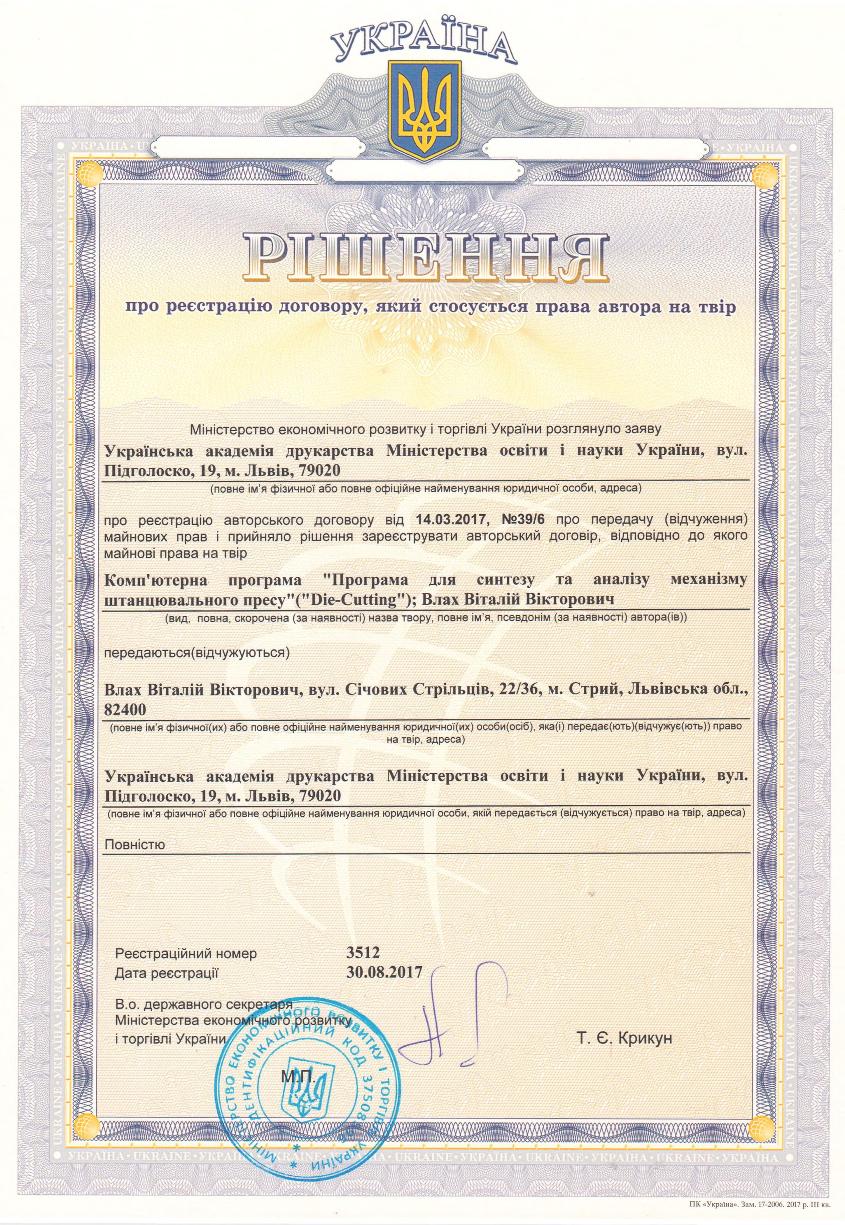
Multiple programs from this work are protected by Ukrainian software copyright certificates:
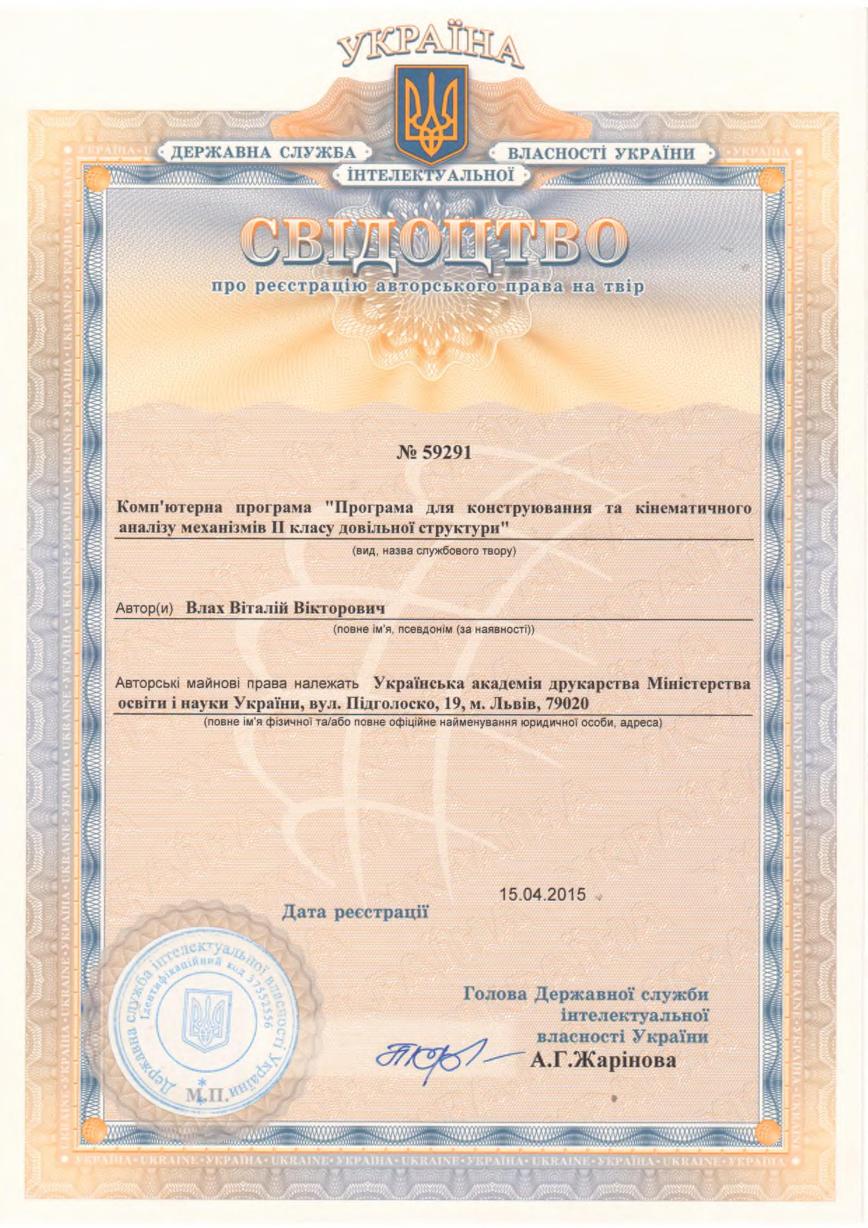
- Certificate No. 59291 — Construction and kinematic analysis of the mechanisms of the second class.
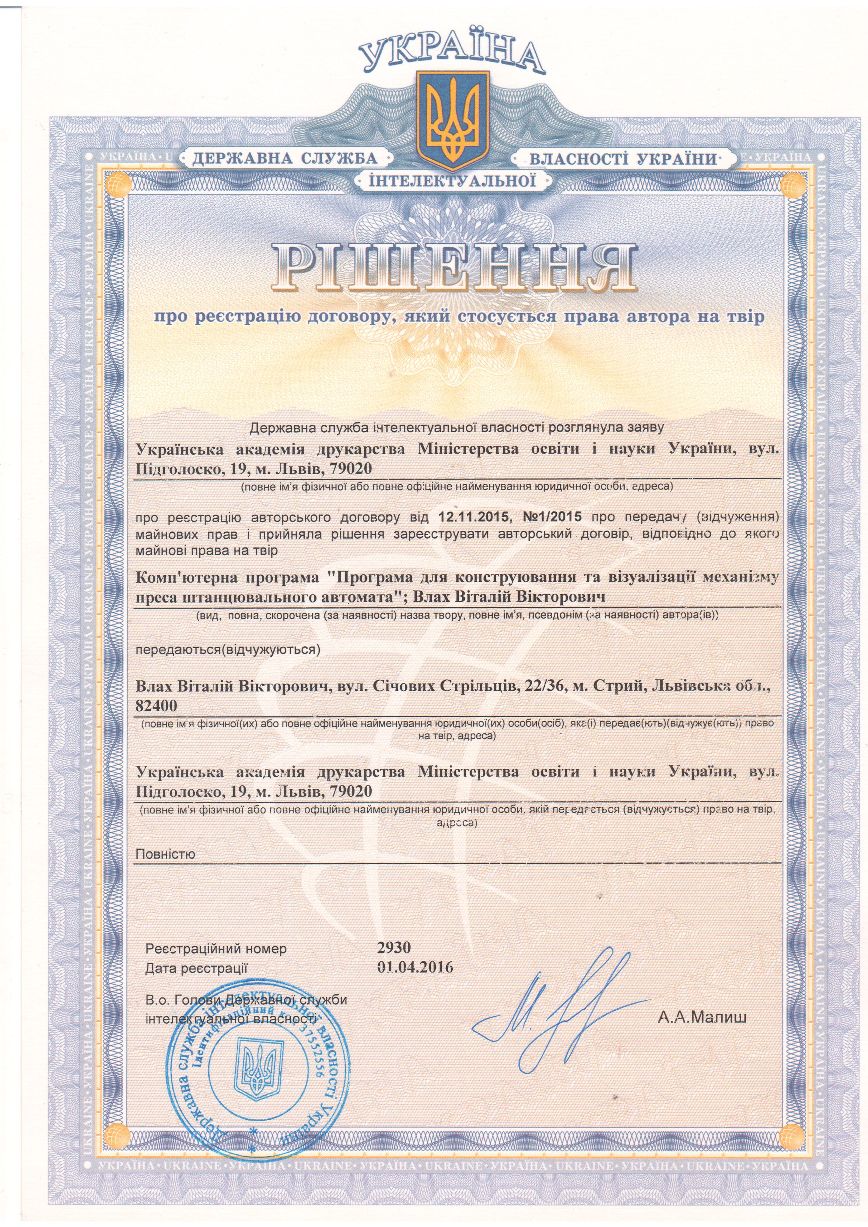
- Certificate No. 2930 — Constructing and visualizing the mechanism of the die-cutting machine.
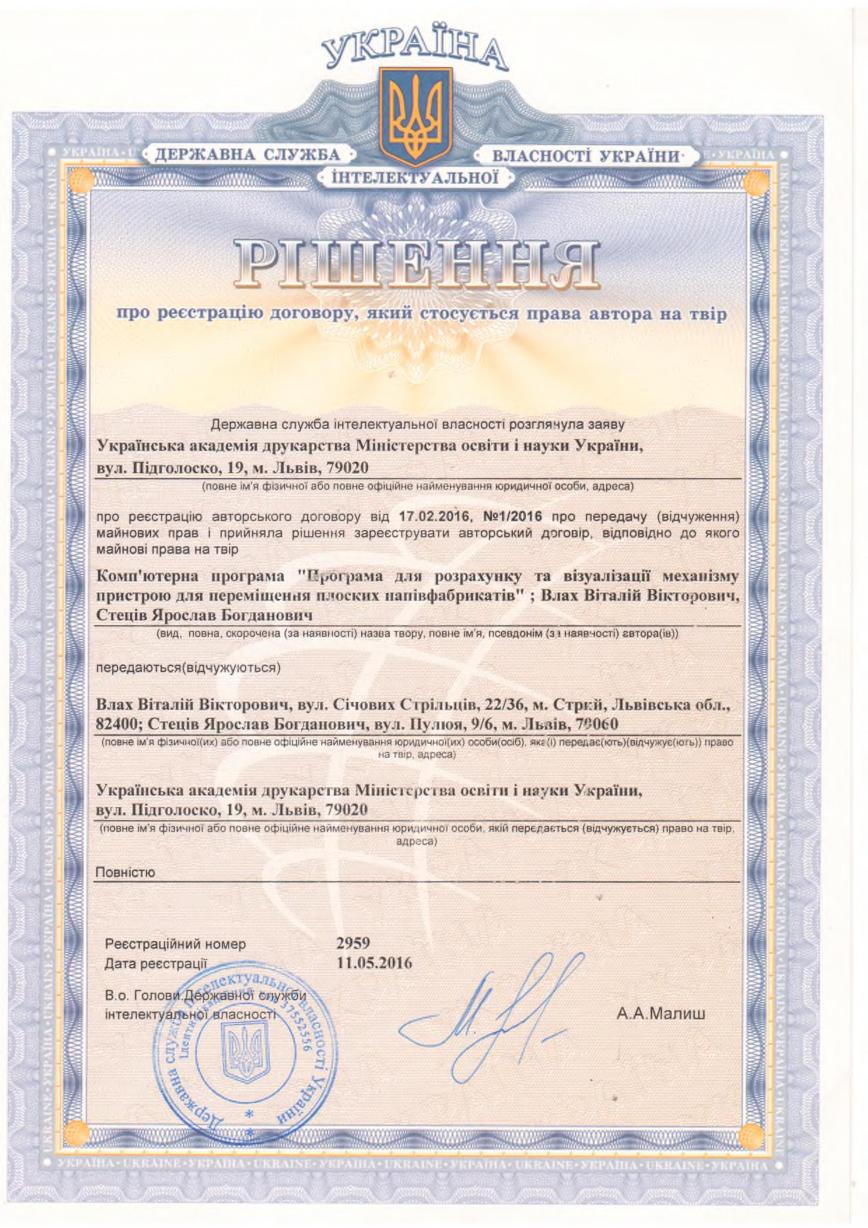
- Certificate No. 2959 — Calculating and visualizing the mechanism of semi-product movement.
- Certificate No. 2987 — Synthesis of the mechanism of the die-cutting machine.
- Certificate No. 3511 — Synthesizing the wedging mechanisms of the die-cutting machines.
- Certificate No. 3512 — Synthesis and analysis of the mechanism of the die-cutting machine.
Continued as DXNest Motion
The web generation of this work is now developed as a product: DXNest Motion, browser-based kinematics software for constructing, simulating, and analysing planar mechanisms. It carries the same modelling scope forward — links and kinematic pairs, one- and two-link slider groups, slotted-link mechanisms, gear trains, gear sectors and internal gears, racks, eccentric drives, roller contacts, and rolling segments — and adds a constraint solver for the full input cycle, comparative graphs across mechanisms open in separate tabs, and JSON, CSV, SVG, DXF, and XLSX export. The research programs listed above remain the origin of its solver and of the comparison workflow used in the published die-cutting-press studies. Available at motion.dxnest.io.
Stack: Delphi / Object Pascal, VCL, GDI+, TeeChart, AutoCAD/Excel/Word OLE automation, Python, React, JavaScript, SVG, and Vite.