
Abstract
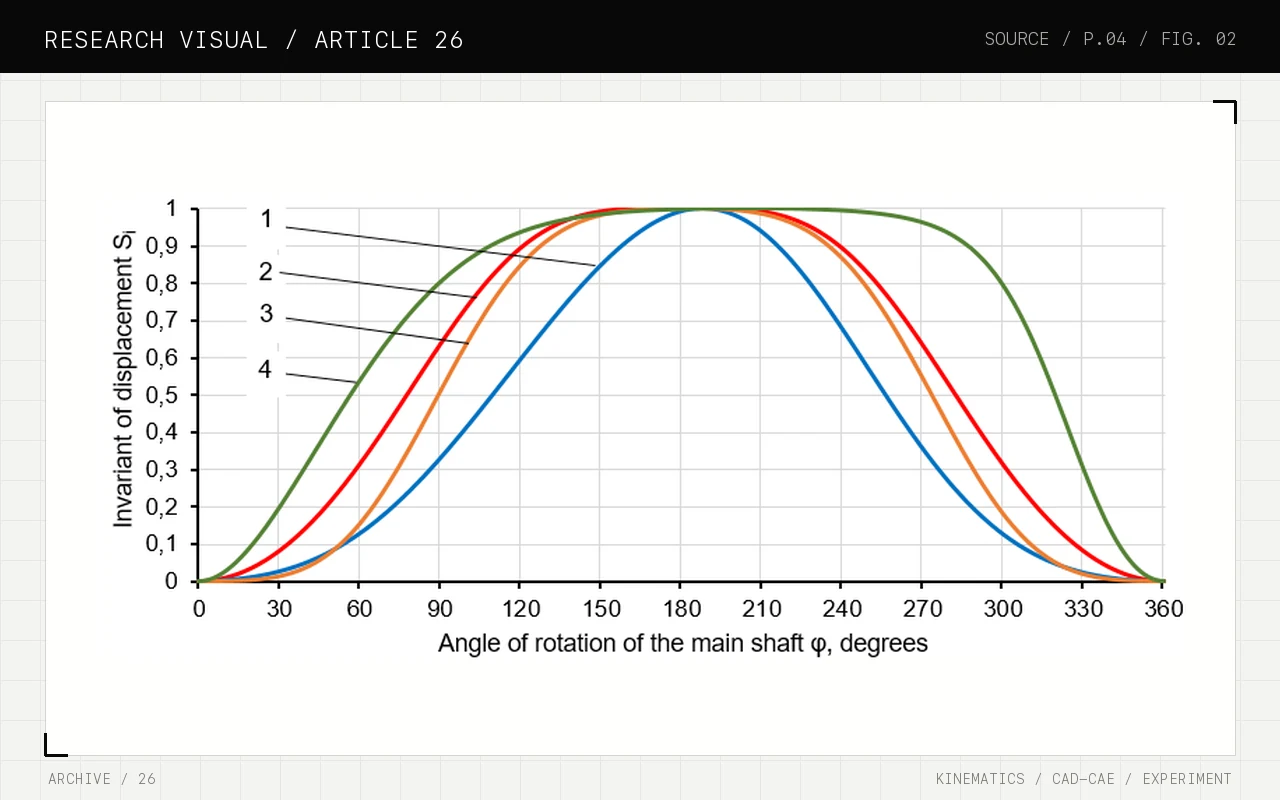
This paper presents an invariant-based framework for the scalable kinematic comparison of pressure-plate (platen) drive mechanisms used in die-cutting presses. The maximum platen stroke is adopted as a unit displacement invariant (λS = 1), which allows displacement, velocity, and acceleration to be expressed in dimensionless form as functions of the main-shaft angle. Four drive architectures — the existing wedging mechanism, a two-slider layout, a wedging mechanism with an additional driven crank, and a double-wedging mechanism — are evaluated using contact-interval metrics defined by a normalised displacement threshold (Si(φ) ≥ 0.98). The approach exposes distinct motion-law features, including asymmetric strokes and the long dwell (“plateau”) behaviour in the contact zone that is critical for embossing and creasing: contact lasts 0.07 of a full main-shaft revolution for the existing wedging drive against 0.32 for the double-wedging drive. To validate the analytical invariants, a closed-loop workflow is implemented in which the mechanism geometry is synthesised in Python, transferred to SolidWorks through automated parameter transfer, and verified against Motion Study results exported to CSV, while experimental acceleration measurements taken at constant shaft speed confirm the characteristic shape features of the predicted curves. The methodology provides a practical, scale-consistent tool for mechanism selection and motion-law tuning in press applications.
Keywords: similarity theory, dimensionless modelling, invariant normalization, die-cutting press, pressure plate drive, wedging mechanism, kinematic analysis, SolidWorks Motion Study, experimental validation, Python integration
How to cite this article
Vitalii Vlakh, Ivan Rehei, Oleh Knysh (2026). Scale-invariant kinematic comparison of pressure-plate drives in die-cutting presses using a unit nit displacement invariant. FME Transactions, Vol. 54, No. 3. https://doi.org/10.5937/fme2603485V