
Abstract
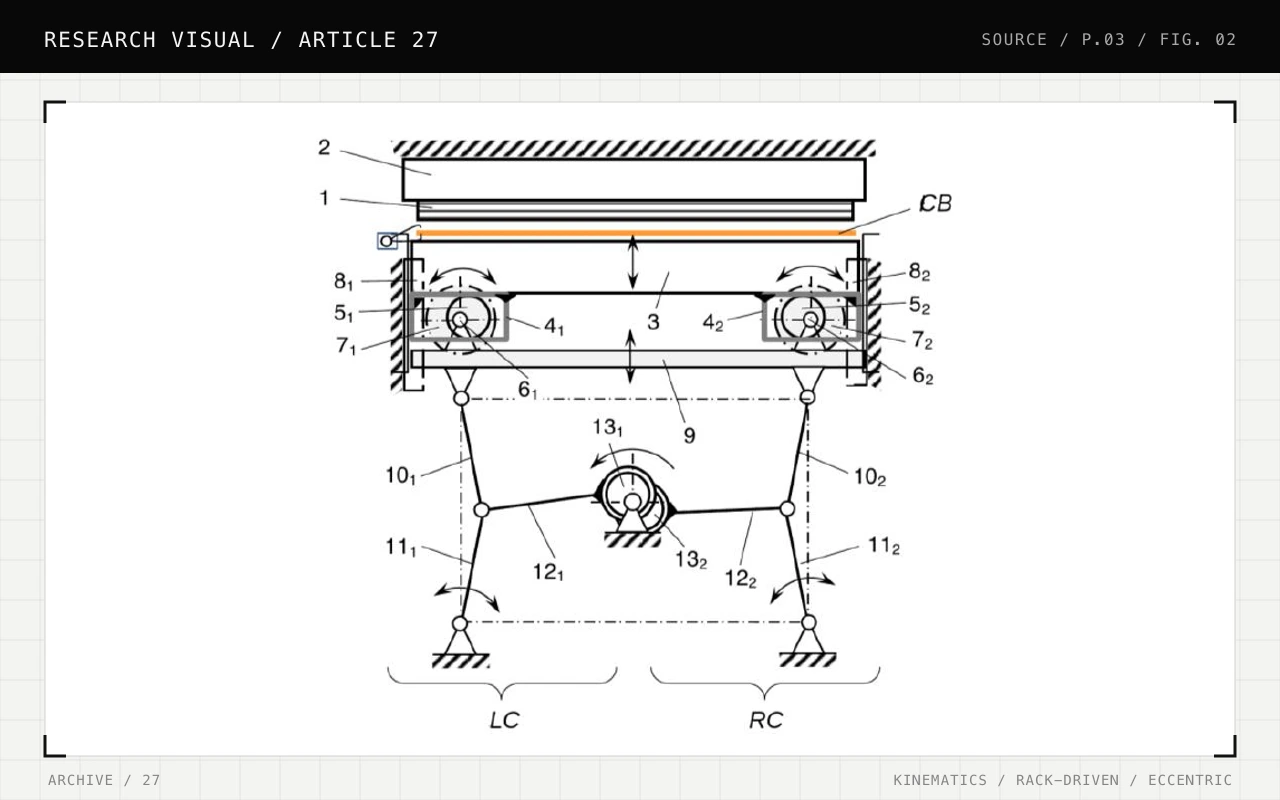
This study develops a kinematic correction for the pressure plate of a flat-bed die-cutting press by supplementing the main wedging drive with rack-driven eccentric mechanisms. The input stroke is recalculated so that every corrected configuration reaches the same normalised maximum while retaining an 80 mm working stroke, which enables a consistent comparison of three relative eccentricities and four eccentric start positions. At a relative eccentricity of 0.10, the left start position widens the calculated near-top dwell angle from 14.4° to 17.4° and reduces the magnitude of the dominant negative acceleration invariant from 1.5299 to 1.0564. Separate tests on a related sectional-plate eccentric stand found peak-torque reductions of 18–31% along the fibres and 23–42% across them, supporting the principle of temporal load redistribution while remaining indirect evidence rather than direct validation of the proposed single-plate mechanism.
Keywords: die-cutting press, pressure plate, cardboard blank, eccentric mechanism, wedging mechanism, kinematic correction
How to cite this article
Vitalii Vlakh, Ivan Rehei, Oleh Knysh, Nazar Kandiak (2026). Kinematic correction of the pressure plate motion in a die-cutting press using rack-driven eccentric mechanisms. Proceedings on Engineering Sciences, Vol. 8, No. 3, pp. 2197–2208. https://doi.org/10.24874/PES08.03B.011