This paper reports analytical research into the torques arising during the cutting of cardboard in a die-cutting press equipped with eccentrics in the pressure-plate drive. Experimental cutting data are interpreted analytically to describe how the resistance torque varies with the plate position throughout the cutting phase. The resulting dependencies link material resistance, plate kinematics, and drive loading, providing a basis for sizing the drive and predicting power demand. The findings improve the accuracy of engineering calculations for die-cutting equipment.
This conference paper provides the technical justification for a sectional construction of the pressure plate in a die-cutting press. It analyses the loads acting on the plate during cutting and shows how splitting the plate into sections reduces the peak drive force and the elastic deformation of the plate. The reasoning supports the transition from monoblock to sectional pressure plates in high-load die-cutting equipment.
This trade-journal article discusses the prospects of replacing the monoblock pressure plate of die-cutting equipment with a sectional one. Written for an engineering-practitioner audience, it explains how a sectional plate distributes the cutting load, lowers drive loading, and can improve the productivity and reliability of carton-packaging production. The article outlines the design considerations for moving from a monoblock to a sectional plate.
This article presents an innovative technical search for the design of the pressure-plate drive in a die-cutting press. It reviews the limitations of conventional drives and outlines wedging-mechanism-based concepts that smooth the plate’s motion and reduce inertial loads, aimed at improving the quality and stability of cardboard die-cutting. The article frames the direction of the author’s subsequent research and patents.
This paper experimentally evaluates how the speed regime of a die-cutting press affects the force loading of the combined pressure-plate drive mechanism during cardboard cutting. Measurements across a range of cyclic speeds relate the drive loading to the operating rate and to the resistance of the cardboard. The results quantify how higher cyclicity increases inertial loading and inform the selection of a working speed that balances productivity and drive load.
A family of custom engineering programs for the synthesis, kinematic and dynamic analysis, and visualization of machine mechanisms, applied in scientific research, university courses, and industrial experiments. Several generations were built — from Delphi / Object Pascal desktop applications to a modern React + Python web version, which is now continued commercially as DXNest Motion.
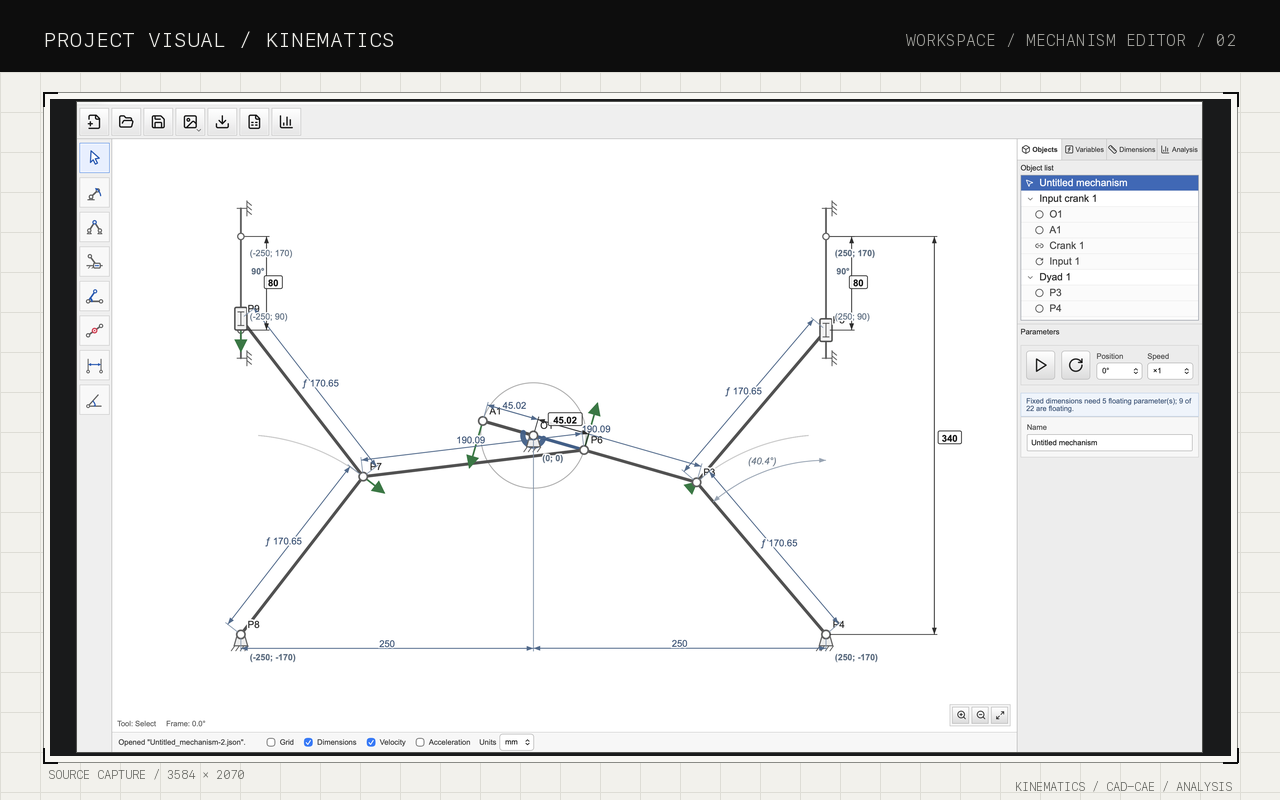
Mechanism editor with dimensions, velocity vectors, and the object tree.
Capabilities
Automated kinematic and dynamic analysis of crank mechanisms, linkages, cam mechanisms, kinematic pairs, and Assur groups.
Calculation of positions, trajectories, velocities, accelerations, link and angular parameters, forces, reactions, and driving torque over a full cycle.
Interactive construction, animation, trajectory and vector visualization, and engineering dimensioning.
Export and reporting to JSON, CSV, SVG, DXF, XLSX, PNG/JPEG, AutoCAD drawings, Excel tables, and Word reports, including AutoLISP generation of 3D models for AutoCAD.
Registered software
Multiple programs from this work are protected by Ukrainian software copyright certificates:
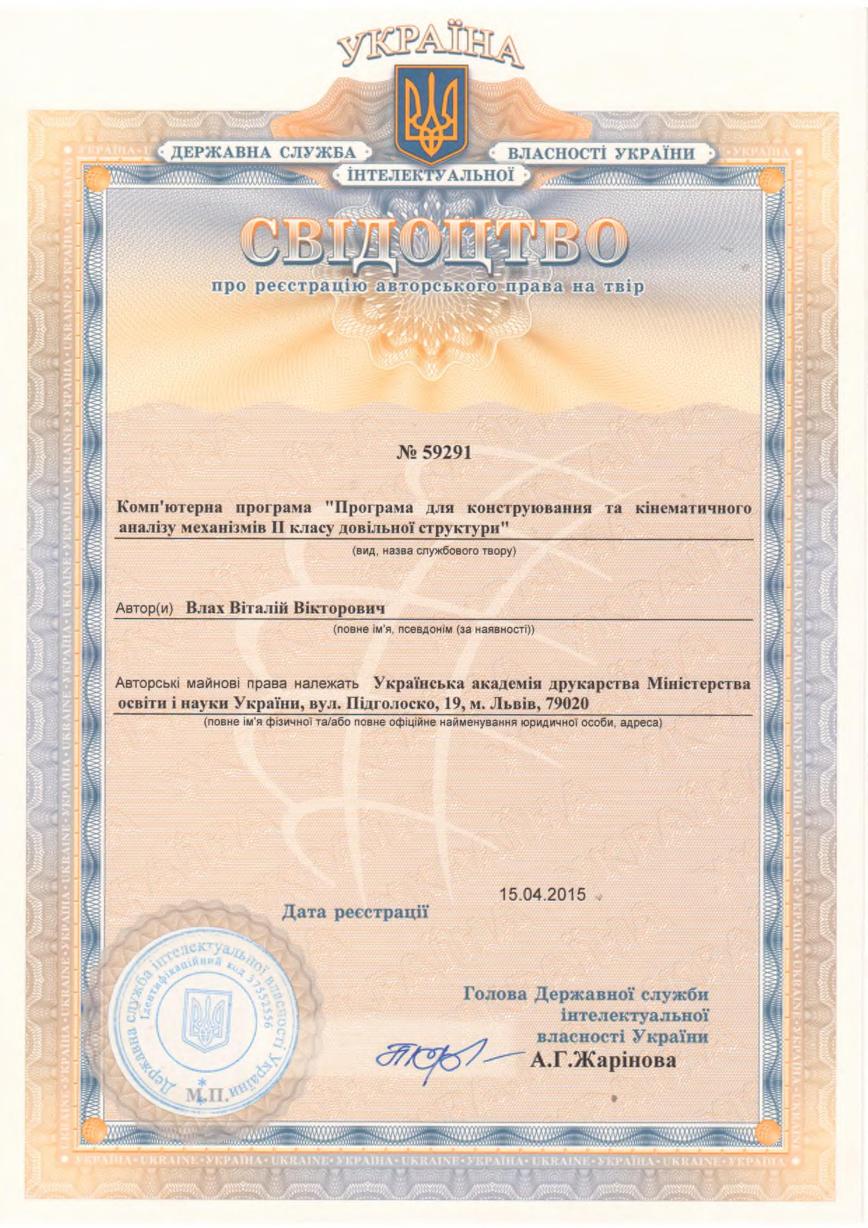
Certificate No. 59291 — Construction and kinematic analysis of the mechanisms of the second class.
Certificate No. 2930 — Constructing and visualizing the mechanism of the die-cutting machine.
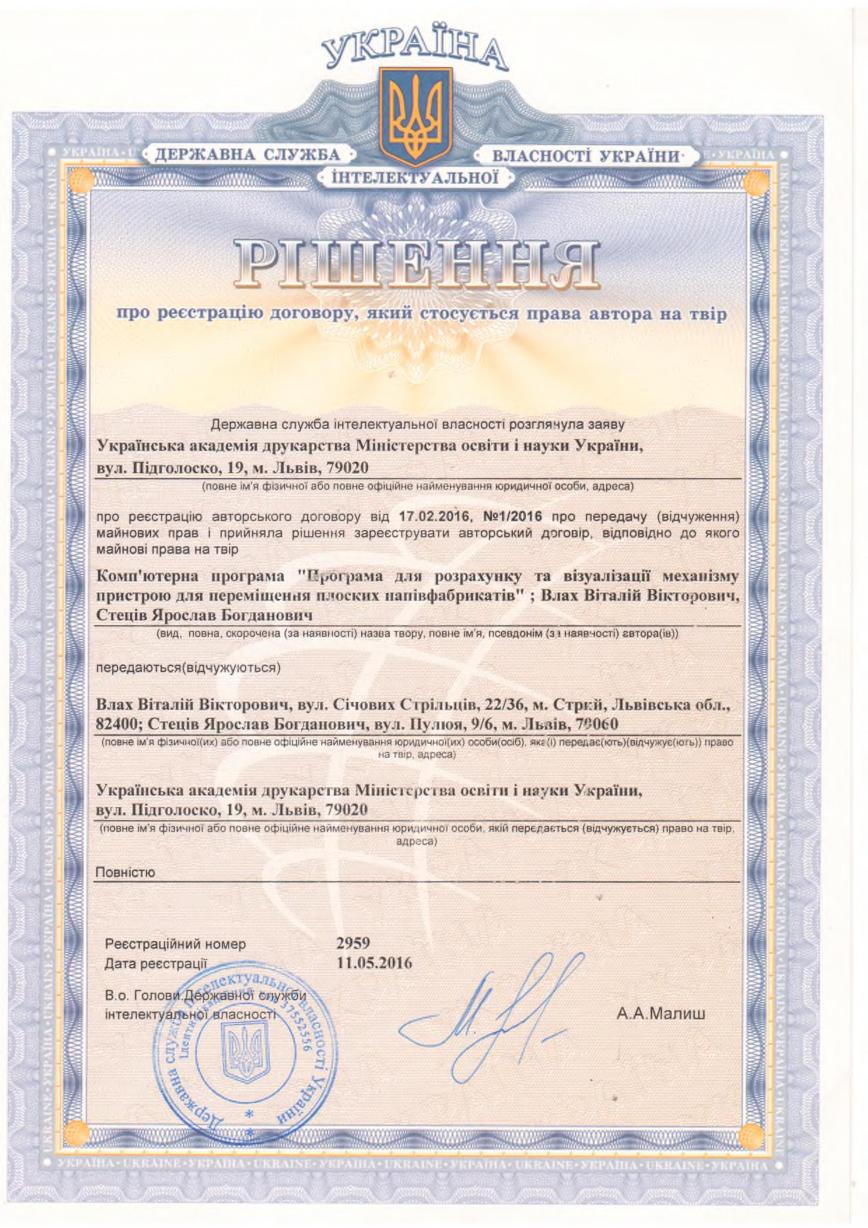
Certificate No. 2959 — Calculating and visualizing the mechanism of semi-product movement.
Certificate No. 2987 — Synthesis of the mechanism of the die-cutting machine.
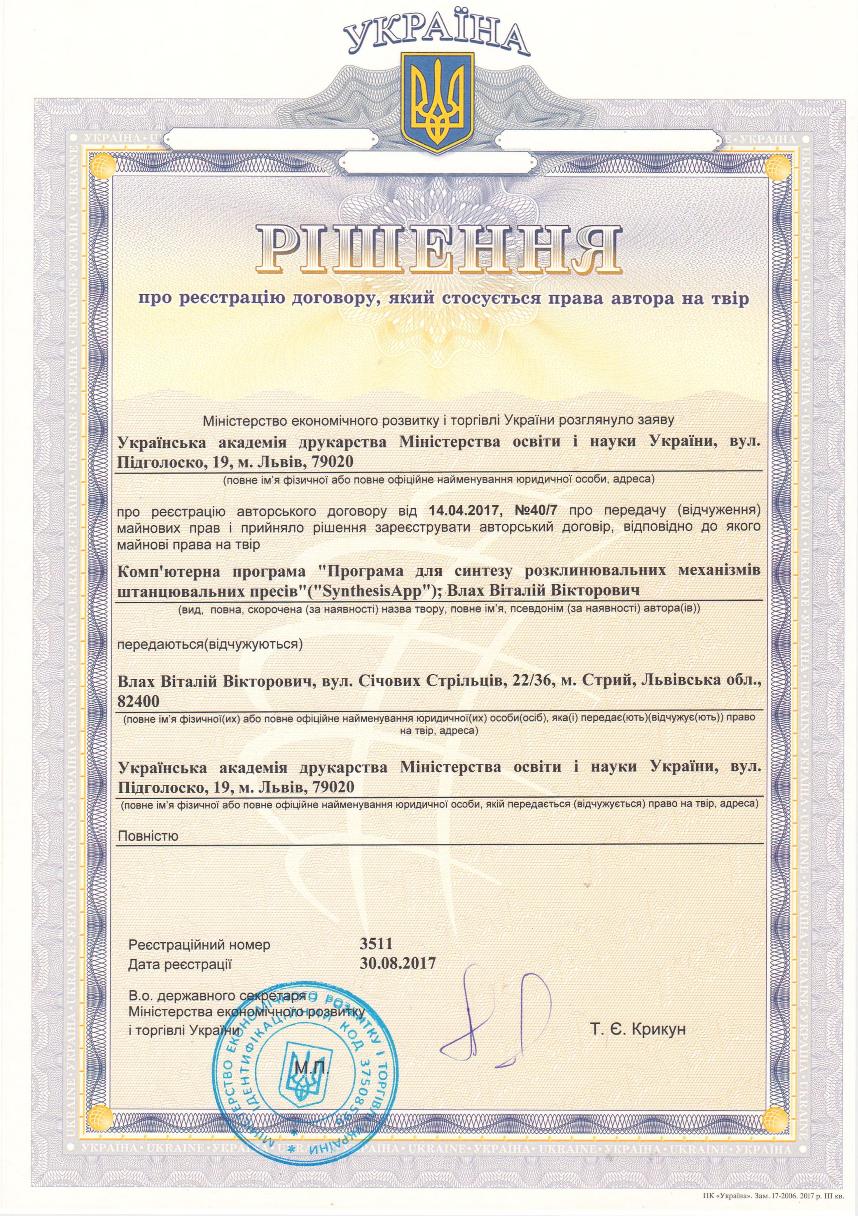
Certificate No. 3511 — Synthesizing the wedging mechanisms of the die-cutting machines.
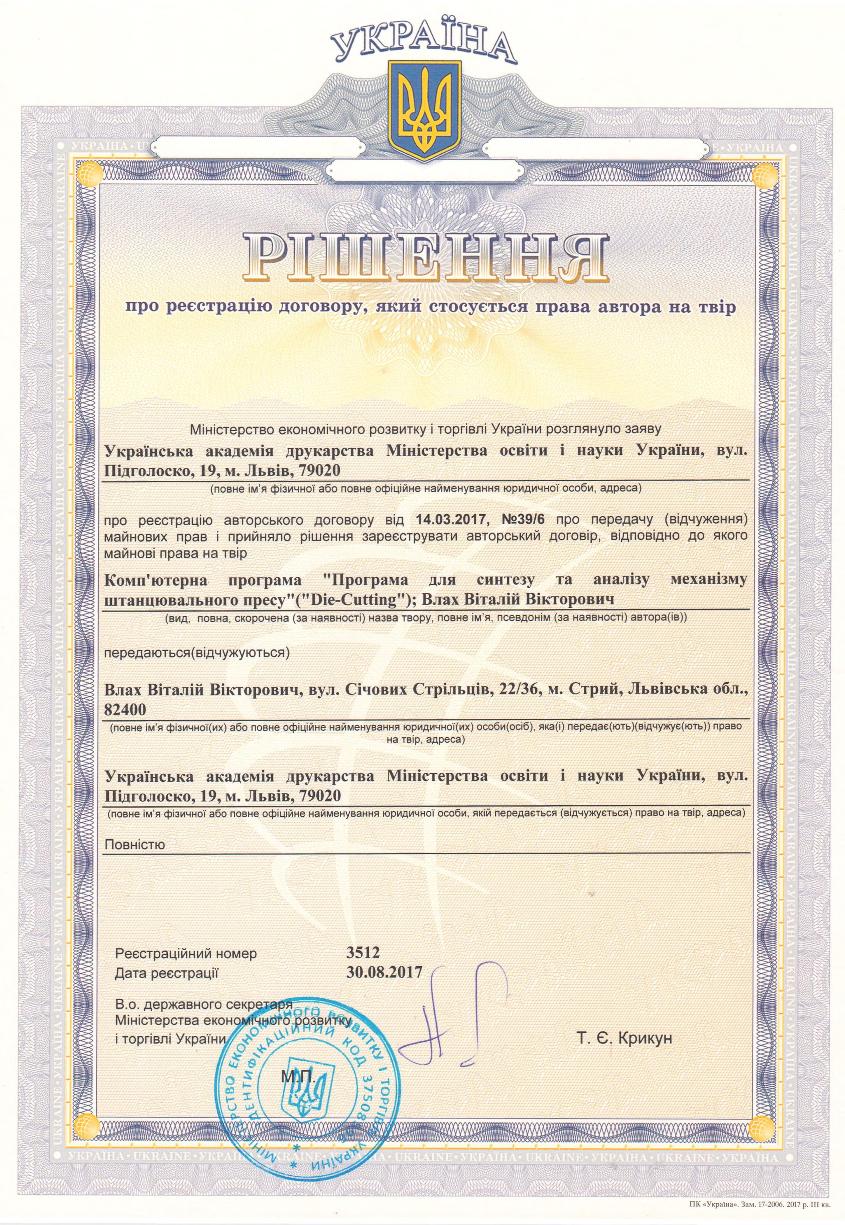
Certificate No. 3512 — Synthesis and analysis of the mechanism of the die-cutting machine.
Continued as DXNest Motion
The web generation of this work is now developed as a product: DXNest Motion, browser-based kinematics software for constructing, simulating, and analysing planar mechanisms. It carries the same modelling scope forward — links and kinematic pairs, one- and two-link slider groups, slotted-link mechanisms, gear trains, gear sectors and internal gears, racks, eccentric drives, roller contacts, and rolling segments — and adds a constraint solver for the full input cycle, comparative graphs across mechanisms open in separate tabs, and JSON, CSV, SVG, DXF, and XLSX export. The research programs listed above remain the origin of its solver and of the comparison workflow used in the published die-cutting-press studies. Available at motion.dxnest.io.
Stack: Delphi / Object Pascal, VCL, GDI+, TeeChart, AutoCAD/Excel/Word OLE automation, Python, React, JavaScript, SVG, and Vite.
Scientific research on die-cutting press pressure-plate drive mechanisms is analysed and, based on the results, an upgraded drive is proposed that combines two wedging mechanisms, an additional pair of driven cranks, and a gear transmission. A geometric synthesis of the mechanism determines its relative and absolute dimensions, and a methodology based on similarity theory is developed to calculate its kinematic parameters, yielding analytical expressions for the invariants of the mechanism’s motion. A 3D model is designed from the synthesis results and a virtual experiment is conducted in SolidWorks. For a press operating at 60 cycles per minute with an 80 mm plate displacement, the maximum speed reaches 0.372 m/s while inertial loads at plate reversal remain minimal (negative acceleration of −0.139 m/s²), confirming the effectiveness of the proposed drive.
The die-cutting of large-format cardboard concentrates very high forces on the pressure plate and its drive. This paper argues for replacing the traditional monoblock pressure plate with a two-section design, in which the plate is split into independently driven sections. Dividing the load between sections lowers the instantaneous force on the drive, reduces plate deformation, and improves the uniformity of cutting and creasing. The study defines the conditions under which the two-section plate is justified for high-capacity die-cutting automata.
This conference paper reasons for the use of a crank-gear drive of the pressure segment in a sectional die-cutting press. It shows how combining a crank mechanism with a gear transmission shapes the motion of the pressure segment, increasing the dwell during cutting and reducing inertial loads. The proposed drive is presented as a route to higher productivity and better cut quality in sectional die-cutting equipment.
This paper studies the movement of the pressure plate driven by wedging mechanisms in a flat die-cutting press. Analytical relationships are derived for the displacement, velocity, and acceleration of the plate over the working cycle, and the influence of the wedging-mechanism parameters on the motion is examined. The results show how the wedging drive shapes the plate’s approach and dwell during cutting, providing a basis for tuning the drive to reduce impact and improve cut quality.