Journal

Topic: Mechanisms

2025–present

Founder / software developer

DXNest Motion

DXNest Motion is browser-based kinematics software for constructing, simulating, and analysing planar mechanisms — linkages, sliders, gears, racks, eccentric drives, rollers, and rolling segments. A mechanism is built on an engineering canvas, solved over its full input cycle, inspected as trajectories and motion curves, and exported as drawings or calculation data, with nothing to install.

It is the second product of DXNest and the direct commercial successor to a decade of mechanism calculation software written for die-cutting-press research. The companion product, DXNest Fabrication, covers CAD/CAM production preparation.
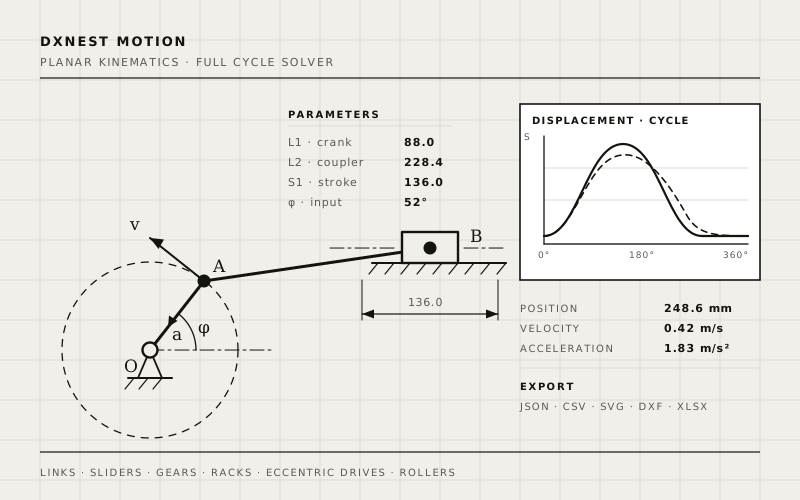
DXNest Motion workspace: a planar linkage on an engineering canvas with trajectory, velocity vectors, and a displacement graph
DXNest Motion — mechanism canvas, solved trajectory, velocity vectors, and cycle graph.

What it does

  • Builds planar mechanisms from links, revolute pairs, one- and two-link slider groups, and pivoted slotted-link mechanisms.
  • Models multi-wheel external gear trains, internal gears and gear sectors, fixed and driven racks, eccentric drives, roller contacts, and rolling pressing segments.
  • Solves the complete input cycle with a constraint solver and animates every solved position.
  • Calculates displacement, velocity, and acceleration for points, links, sliders, gears, segments, and roller contacts.
  • Overlays calculated curves from several mechanisms open in different tabs for direct comparison.
  • Exports project data and results as JSON, CSV, SVG, DXF, and XLSX, including per-object cycle tables and charts.

Why it exists

The kinematic comparison of drive mechanisms that underpins this line of research — wedging drives, two-slider layouts, additional driven cranks, and double-wedging mechanisms — previously required custom desktop programs, Mathcad models, and SolidWorks Motion studies stitched together by hand. DXNest Motion collapses that workflow into one browser workspace, so a mechanism concept can be dimensioned, solved, compared against alternatives, and exported into engineering documentation in a single session.

Architecture & stack

An interactive SVG engineering canvas with multiple mechanism tabs, an object list, parameter and dimension panels, and light and dark drafting themes, backed by a constraint-based cycle solver with differentiated velocities and accelerations. Built as a browser application on a React and Python stack; projects are kept in the user account at motion.dxnest.io.

Research lineage

The solver and the comparison workflow grew out of six Ukrainian software copyright certificates for mechanism synthesis and analysis programs and out of peer-reviewed work on die-cutting-press pressure-plate drives. See the Publications and Patents & certificates pages for the underlying research record.

2026

FME Transactions, Vol. 54, No. 3

Scale-invariant kinematic comparison of pressure-plate drives in die-cutting presses using a unit nit displacement invariant

This paper presents an invariant-based framework for the scalable kinematic comparison of pressure-plate (platen) drive mechanisms used in die-cutting presses. The maximum platen stroke is adopted as a unit displacement invariant (λS = 1), which allows displacement, velocity, and acceleration to be expressed in dimensionless form as functions of the main-shaft angle. Four drive architectures — the existing wedging mechanism, a two-slider layout, a wedging mechanism with an additional driven crank, and a double-wedging mechanism — are evaluated using contact-interval metrics defined by a normalised displacement threshold (Si(φ) ≥ 0.98). The approach exposes distinct motion-law features, including asymmetric strokes and the long dwell (“plateau”) behaviour in the contact zone that is critical for embossing and creasing: contact lasts 0.07 of a full main-shaft revolution for the existing wedging drive against 0.32 for the double-wedging drive. To validate the analytical invariants, a closed-loop workflow is implemented in which the mechanism geometry is synthesised in Python, transferred to SolidWorks through automated parameter transfer, and verified against Motion Study results exported to CSV, while experimental acceleration measurements taken at constant shaft speed confirm the characteristic shape features of the predicted curves. The methodology provides a practical, scale-consistent tool for mechanism selection and motion-law tuning in press applications.

2023

Academic Journal of Manufacturing Engineering, Vol. 21, Issue 1

Analytical interpretation of experimental research of cardboard cutting in die-cutting press

This paper reports analytical research into the torques arising during the cutting of cardboard in a die-cutting press equipped with eccentrics in the pressure-plate drive. Experimental cutting data are interpreted analytically to describe how the resistance torque varies with the plate position throughout the cutting phase. The resulting dependencies link material resistance, plate kinematics, and drive loading, providing a basis for sizing the drive and predicting power demand. The findings improve the accuracy of engineering calculations for die-cutting equipment.

2023

InterConf, International scientific conference

Technical justification of the sectional construction of the pressure plate in the die-cutting press

This conference paper provides the technical justification for a sectional construction of the pressure plate in a die-cutting press. It analyses the loads acting on the plate during cutting and shows how splitting the plate into sections reduces the peak drive force and the elastic deformation of the plate. The reasoning supports the transition from monoblock to sectional pressure plates in high-load die-cutting equipment.

2023

Upakovka (Packaging), 6/2023

Die-cutting equipment press: prospects of replacing the monoblock pressure plate with a sectional one

This trade-journal article discusses the prospects of replacing the monoblock pressure plate of die-cutting equipment with a sectional one. Written for an engineering-practitioner audience, it explains how a sectional plate distributes the cutting load, lowers drive loading, and can improve the productivity and reliability of carton-packaging production. The article outlines the design considerations for moving from a monoblock to a sectional plate.

2023

Upakovka (Packaging), 2/2023

Pressure plate drive in a die-cutting press: an innovative technical search for the design

This article presents an innovative technical search for the design of the pressure-plate drive in a die-cutting press. It reviews the limitations of conventional drives and outlines wedging-mechanism-based concepts that smooth the plate’s motion and reduce inertial loads, aimed at improving the quality and stability of cardboard die-cutting. The article frames the direction of the author’s subsequent research and patents.

2021

Printing and Publishing

Experimental evaluation of the influence of the speed regime on the force loads of the combined pressure-plate drive mechanism during cardboard die-cutting

This paper experimentally evaluates how the speed regime of a die-cutting press affects the force loading of the combined pressure-plate drive mechanism during cardboard cutting. Measurements across a range of cyclic speeds relate the drive loading to the operating rate and to the resistance of the cardboard. The results quantify how higher cyclicity increases inertial loading and inform the selection of a working speed that balances productivity and drive load.

2021

Scientific Papers of the Ukrainian Academy of Printing

Combined drive mechanism of the pressure plate of a flat die-cutting press: experimental evaluation of loads

This paper reports an experimental evaluation of the loads in the combined drive mechanism of the pressure plate of a flat die-cutting press. A test setup measures the forces and torques acting on the drive during cardboard cutting, and the measured data are compared with analytical estimates. The study validates the load model of the combined mechanism and clarifies the conditions that govern its power demand.

2017

Upakovka (Packaging), 5/2017

Pressure-plate drive mechanism in die-cutting equipment: justification of the improvement

This trade-journal article justifies the need to improve the pressure-plate drive mechanism used in die-cutting equipment. It describes the technological demands of die-cutting, identifies the shortcomings of the existing drive, and outlines directions for its modernisation to raise productivity and cutting quality. The article sets the practical context for the author’s research on improved drive mechanisms.

2016

Printing and Publishing

Kinematic synthesis of a die-cutting press mechanism from the condition of equal forward and return strokes

This paper performs the kinematic synthesis of a die-cutting press mechanism under the condition of equal forward and return strokes of the pressure plate. Analytical relationships are derived that size the mechanism links so that the working and idle strokes are balanced, which stabilises the machine’s cyclic motion. The synthesised mechanism provides a basis for a smoother, better-balanced die-cutting drive.